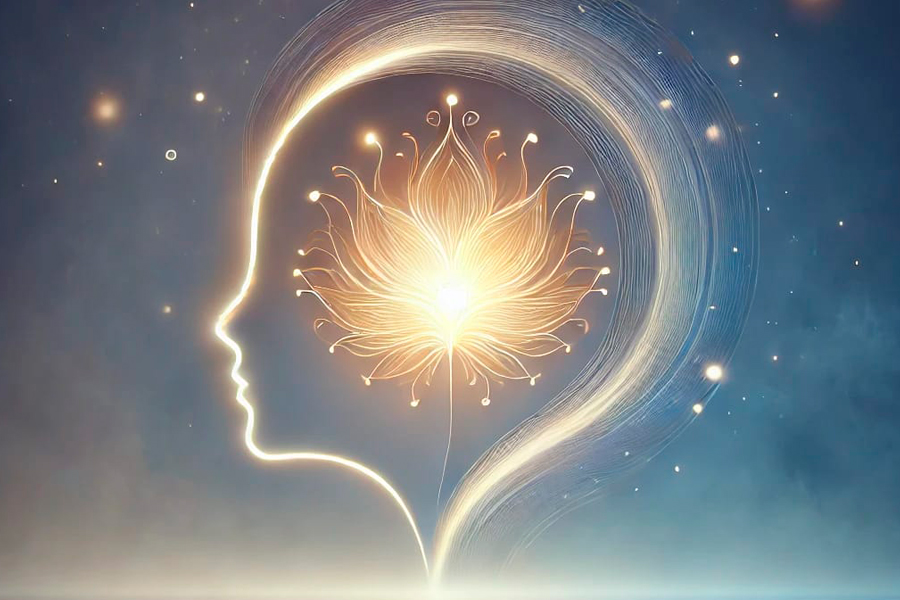
Have you ever wondered what meditation is for or how to meditate?
There are various ways or techniques you can choose to meditate. There are also many reasons why you should meditate.
Just do a simple search on the Internet and you’ll find loads of options. I’m convinced that the most important thing, above all, is that you reflect on yourself.
Pay attention to how you breathe.
Becoming aware of your breathing is already a meditation.
What did you feel? Did you notice something different? Did something catch your eye? Was something difficult or easy?
Breathing requires three moments.
Inhaling is the first. Then comes a stop. There is a stop. It can be short, it can be long, but there is one. Have you noticed? Then the third moment – exhalation.
It’s a rhythm.
One of the reasons why we learn and meditate in Cafh is this: to become aware of ourselves, of what we think, of what we feel. We don’t always realize how we think and why we think what we think.
We meditate to discover ourselves. We also meditate to take conscious and responsible action and decisions.
To do this, we use different techniques. The one we’re going to talk about here is powerful and very simple.
We call it discursive meditation. Here we go.
Like the breathing process, discursive meditation takes place in three stages: invocation – silence/waiting – response.
Choose a chair that is comfortable but firm and that doesn’t make it easy for you to fall asleep.
Sit with your feet flat on the floor, your heels aligned. Keep your back straight and try not to lean on the back of the chair. Put your hands together at chest height or on your hips. Get comfortable.
Feel your body firm and your mind clear.
Begin by mentally or vocally expressing the following steps:
Invocation (first moment)
If you practice any religion or feel devotion to some saint, superior being, divine being or God, raise your thoughts to that being.
If not, think about nature, the cosmos, or measure yourself, your deepest self, connect with the rhythm of your heart.
Invoke that being. Llámalo.
Think about what you want to meditate on, what topic, what you’re looking for, what distracts you, worries you, or something that brings you joy, a good moment of happiness.
Is it a desire, a dream, a difficulty, a joy? Let’s talk about it. Tell us.
There’s no need to hide anything. Remember that no one is listening, just you and your light, your guide.
Speak, let your ideas, your thoughts come out. Ask questions, ask for help. Speak freely, whatever comes. Let it go.
Silence/Waiting (second moment)
This is the moment to observe your mind.
Inténtalo. See that I’ve told you to try not to give an answer to the topic you raised in the previous step. Observe your mind, try to keep it fixed on a “neutral point”.
Observa, cuando te des cuenta de que aparece un pensamiento, otra idea, suéltala, no luches contra ella, suéltala e intenta fijarla de nuevo en esse punto neutro. Stay in that movement.
Normally, when we think about waiting, we think about waiting for something, for someone, or even waiting for a response. In our case, this moment of waiting in meditation consists of creating a space of inner silence, it’s like a state of suspension, of expectation without an object to wait for. It’s just waiting. Just silence.
This brings us to the third moment.
Answer (third moment)
Now is the moment, let the answer to your theme emerge. Let what arises from this deeper state emerge. Don’t judge or analyze the answer, simply let it emerge.
It could be a complete answer that makes sense to you, or it could be a sentence
that at first doesn’t tell you anything. It could just be a word, an image, an idea.
De nuevo, no reflexiones, no pienses, simply déjate llevar. Absorb the answer.
To end the meditation exercise, say the word Peace.
This moment will continue throughout the day. Ideas can come back to you at different times. Sometimes, something a person says will give you an idea of the Answer that emerged in your meditation. Or something that happens can bring the same awareness. Maybe an explanation, maybe a good idea, maybe a feeling that helps you in your process of knowing yourself.
I’ll stop here.
From here on, it’s up to you. Practice. Después, cuéntanoslo.
Sergio da Cruz
More information about meditation at https://revistacafh.com.br/meditar- e-preciso-3-0/